Laura Lyons’s letter to Sir Charles Baskerville
The Hound of the BaskervillesLaura Lyons’s letter to Sir Charles Baskerville is both a failed appeal for help and a crucial surviving trace of the scheme that brought Sir Charles to the gate on the night he died. Its original body was burned, and only a fragment of its postscript could be read. That fragment connected Laura to the intended meeting; her later admission disclosed the distress behind the appeal, while the investigation established how Stapleton had pressured her to write it and then prevented her from attending.
The letter and its surviving fragment
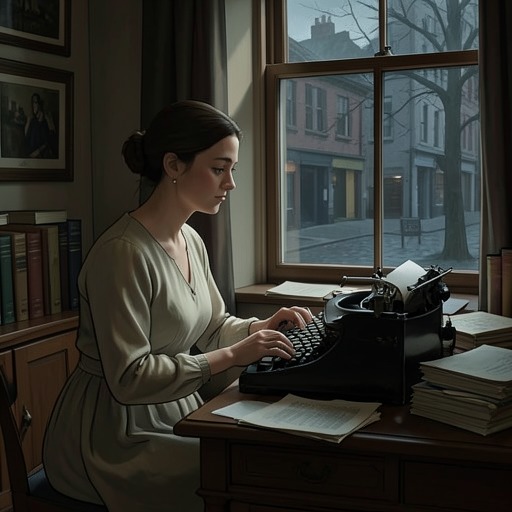
The letter came from Coombe Tracey and was addressed in a woman’s hand. It had arrived on the morning of Sir Charles’s death. He was accustomed to receiving many letters as a public man known for his generosity, but on this particular morning it was the only one. That circumstance made the letter memorable to the household, although its importance was not understood at the time.
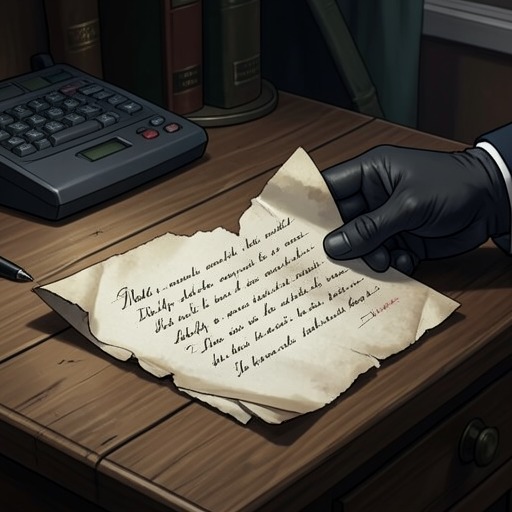
The physical document did not survive intact. Weeks later, while Sir Charles’s study was being cleaned for the first time since his death, the ashes of a burned letter were found at the back of the grate. Most of the paper had been charred beyond reading. A small piece from the end of a page remained legible against the blackened ash: it asked Sir Charles to burn the letter and be at the gate by ten o’clock, and it bore the initials L. L. The fragment crumbled after it was moved, leaving no original piece for later examination.
The surviving words were therefore only a postscript, not the full appeal. They established a requested act of secrecy and a specific rendezvous, but did not, by themselves, explain the writer’s circumstances or her relationship to Sir Charles. Their evidentiary value depended on recollection and recognition: the household remembered the burned fragment, and Laura later acknowledged that she had written the letter.
Laura’s purpose in writing
When confronted with the postscript’s wording, Laura first appeared unable to answer. She then admitted that the letter was hers and said that she had wanted Sir Charles’s help. Her account supplied what the fragment could not: the request for a meeting was not, in her telling, an attempt to entangle him in a personal attachment, but a plea for assistance at a moment when she believed his generosity might offer a way out of her situation.
Laura described a rash marriage that she regretted and a life of continuing persecution by a husband she abhorred. She believed the law favored him and feared that he might force her to live with him. At the time she wrote, she had learned of a possibility of regaining her freedom if certain expenses could be met. She understood that possibility as bearing on her peace of mind, happiness, and self-respect, and hoped that explaining her case in person would persuade Sir Charles to help.
The timing was urgent. Laura had only just learned that Sir Charles intended to leave for London the following day and might be away for months; she said that other reasons had prevented her from approaching him earlier. The postscript’s request for a meeting at ten thus fixed a narrow opportunity before his departure. The letter’s appeal and its secrecy are inseparable: it sought a private conversation with a benefactor, while instructing him to destroy the written request.
Stapleton’s use of the appeal
The letter’s apparent simplicity concealed Stapleton’s role in creating the circumstances around it. Sir Charles had befriended Stapleton and had made him an intermediary in charitable assistance to Laura. Stapleton represented himself to her as a single man and led her to believe that he would marry her if she obtained a divorce. By offering that prospect while presenting himself as a helper, he gained influence over her decisions and her hopes for the future.
According to the later reconstruction, Stapleton pressed Laura to write to Sir Charles, asking him to meet her on the evening before his planned departure for London. He then used a specious argument to keep her from going to the meeting. Laura’s admission that she received help from another source in the interval explains why she did not attend, while Stapleton’s manipulation explains why the letter could still serve his purpose without her presence. The appeal created the expectation that Sir Charles would be waiting at the gate; Stapleton could exploit that expectation while keeping Laura away from the scene.
This arrangement was part of a larger inheritance plot. Sir Charles’s estate was worth close to a million, and the question of who would inherit if the young Sir Henry Baskerville died gave the investigation a financial context. The letter did not disclose that scheme, and Laura wrote it in pursuit of a different, immediate need. Its significance lies in the way Stapleton redirected her appeal: an honest request for aid became a means of drawing Sir Charles into a lethal encounter.
From private message to investigative clue
The letter’s importance emerges through the contrast between its intended function and its eventual one. Laura meant it to secure a confidential interview. Sir Charles burned it, apparently honoring the request for secrecy, but the incomplete remains later brought the concealed meeting back into view. The fragment could not identify its author on its own; initials and remembered wording became a lead only when investigators compared them with Laura’s circumstances and questioned her directly.
That lead helped clarify the sequence surrounding Sir Charles’s death. He had been expected at the gate, and the evidence at the scene included his footprints down Yew Alley, with no other human tracks on the soft gravel beyond those of the butler who found him. A gigantic hound’s footprints were discovered some distance from the body. Sir Charles had no physical injury, and the investigation concluded that he had died from heart disease and terror before the hound reached him. The letter was not itself proof of the attack, but it helped explain why he was at the place where Stapleton could set the hound upon him.
The damaged document also embodies a larger problem of proof. Its most informative surviving portion was temporary, the rest had been deliberately burned, and the last fragment disintegrated. What remained had to pass through several forms: an old household recollection, an almost-lost scrap, a reported transcription, and Laura’s eventual confession. The letter thus mattered less as a complete text than as a broken chain of evidence. It disclosed the rendezvous, opened a route to Laura’s account, and revealed how Stapleton could turn a private appeal into an instrument of murder.